Law as Code – The digital operating system for society

Modern societies operate on the basis of digital rules. Whether they remain capable of functioning depends on how well these rules reflect the complexity of a globalised world.

Law as Code (also referred to as 'Rules as Code' in English) models the law in such a way that it becomes machine-readable, traceable and compatible with digital processes – without relinquishing the normative responsibility of institutions. At LawAsCode.org, we at the Rulemapping Group are continuing to develop this approach together with partners from government, academia and civil society.

Get in touch

Our three mission fields

Three strategic levers through which Law as Code makes an impact.

01
Making legislation manageable

Government legal experts are equipped to create precise, machine-readable decision-making logic. This means that laws can be tested and simulated right from the drafting stage.

02
Empowering public administration and the judiciary

We prioritise human decision-making over blind automation. The ‘human-in-the-loop’ approach ensures that the responsibility for weighing up options and ensuring legitimacy always remains with people.

03
Effective rules for citizens and business

Digital law is becoming user-friendly, predictable and effective. Clear frameworks foster trust and innovation by providing reliable planning certainty for all stakeholders.

Mission & manifesto

Rulemapping translates static text into structured, testable applications. Law as Code is therefore not merely a technical upgrade, but a civilisational step towards safeguarding the rule of law and the capacity for innovation in an environment of exponential complexity.

"Rules form the basis of our social contract. Digitalisation has added a virtual dimension to this system that goes far beyond mere acceleration. It is about new capabilities: universal accessibility, improved coordination and constant up-to-dateness."

Till Behnke, CEO Rulemapping Group

Guiding principles

Five guiding principles that shape our understanding of the law as an open digital infrastructure.

01
Openness as a principle

A functioning operating system requires transparency rather than secrecy.

02
Open Innovation

Cooperation at the core (standards), competition in implementation (solutions).

03
Open Standards

The .ruml file format ensures market access and prevents lock-in effects.

04
Open Source

Genuine trust can only be built through shared development costs and full verifiability.

05
Governance

Government oversight of architecture ensures accountability and reliability.

The Rulemap Builder

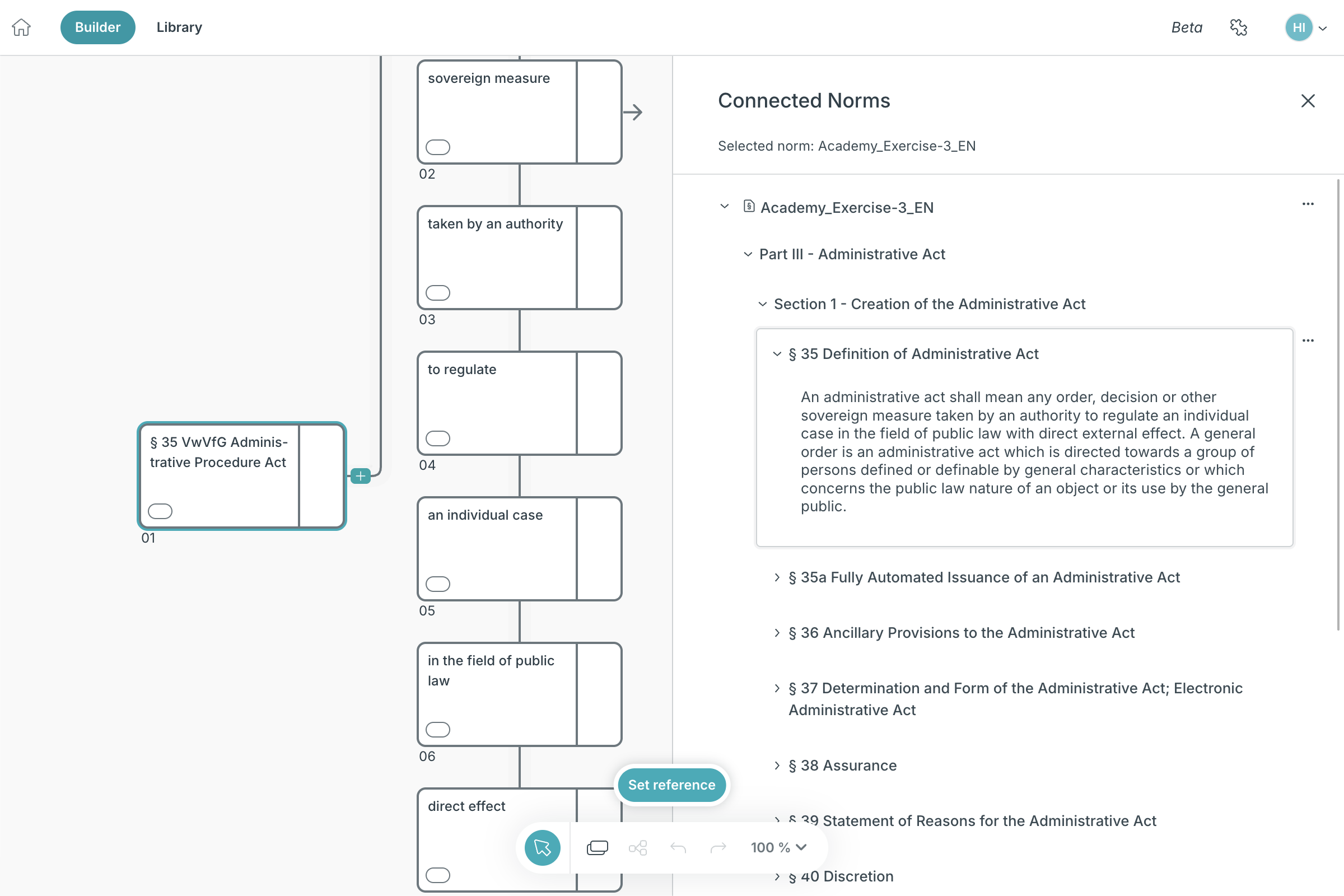
One essential building block of Law as Code: The Rulemap Builder enables laws, regulations, and procedures to be represented and reviewed as visual decision models. It forms the precursor to automating legal processes with Rule AI — a technology that makes legal logic machine-executable. Future development stages will allow AI-assisted generation of Rulemaps, automatic modeling of existing laws, and the creation of legally compliant texts based on Germany's 'Manual for Drafting Legislation' (Handbuch der Rechtsförmlichkeit) — all compatible with standards such as LegalDocML or FIM.

To the Builder

Get involved in the Moonshoot Law as Code Initiative

Research, administration, business, civil society – please get in touch if you would like to join the open alliance.

Get in touch

The Rulemapping Academy

It serves as the centre of excellence for this transformation. Gain the methodological foundation for Law as Code and Rulemapping through practical training and online courses.

To the academy
Why do we need Rulemapping?
LESSON 1
Video
5:16